Deerfield House Featured in Signature Kitchens & Bath (2013)
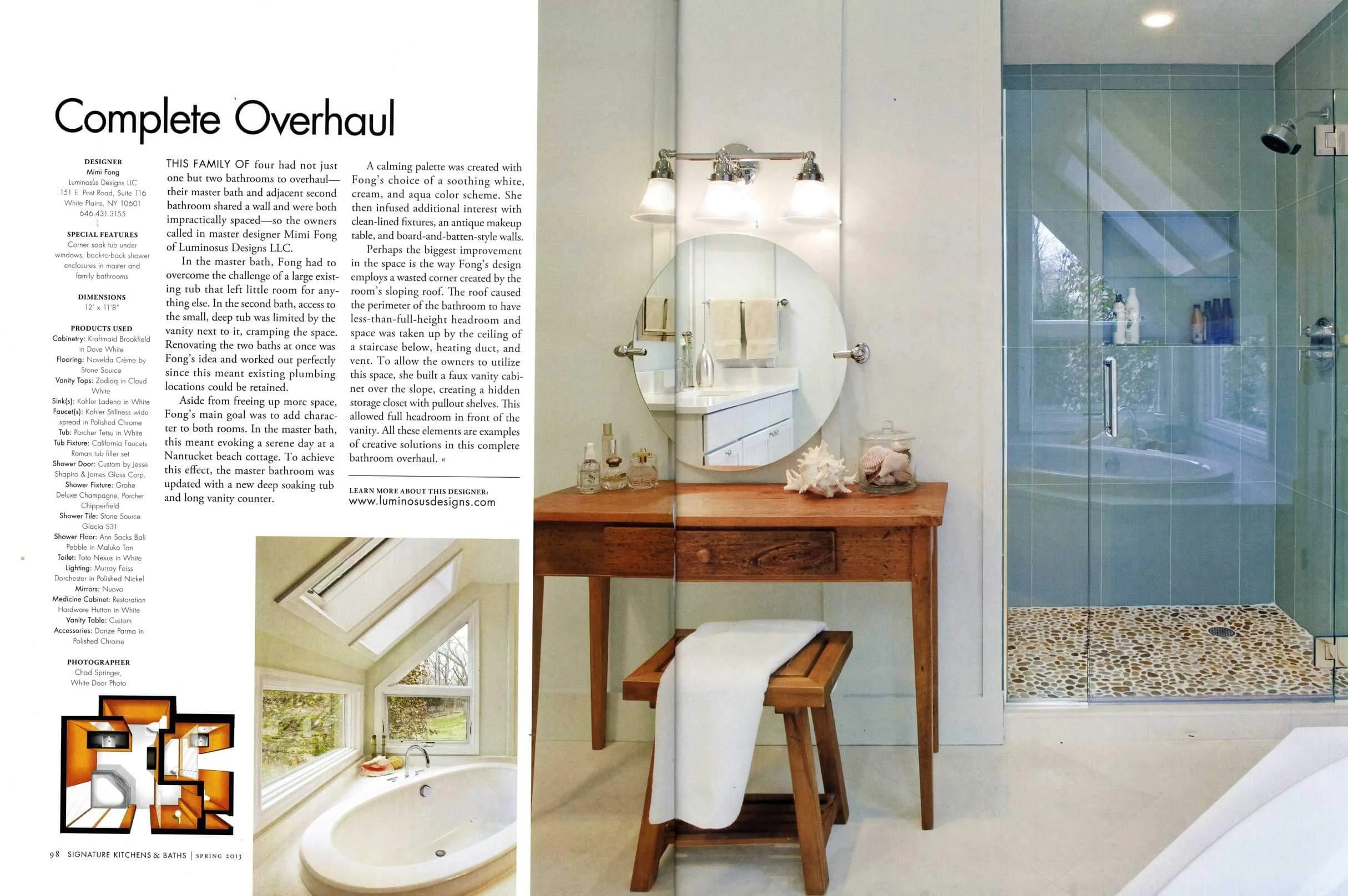
The Deerfield House project was featured in a two-page spread in the March 2013 issue of Signature Kitchens & Bath magazine. The editorial focus of the feature was the home’s primary bathroom, a space whose resolution depended less on surface choices than on the careful negotiation of structure, volume, and daily use.
The room sits above a two-story family room with a vaulted ceiling, and its geometry is shaped by the rooflines and framing required below. This left the original space fragmented by angled planes and residual volume that had resisted earlier attempts at improvement. What made the project notable was not that these conditions were hidden, but that they were absorbed into a plan that made the room finally read as a coherent whole.
The editorial interest of the project lies in this kind of problem-solving. Rather than treating the bathroom as a decorative exercise, the design process began with a reorganization of the space itself. The available volume was clarified, the plan was simplified, and the most difficult structural element — a substantial bulkhead — was integrated into the cabinetry rather than left as a visual interruption.
This approach allowed the room to be generous without becoming diffuse. A soaking tub and a separate shower were introduced in a way that feels natural to the space, not imposed on it. A long vanity establishes continuity across the room, while storage is built into the architecture rather than layered on afterward. The result is a bathroom that feels calm and settled, not because it is minimal, but because it is resolved.
Material choices play a supporting role rather than a starring one. The palette is restrained and light, allowing the room’s proportions and organization to remain the primary experience. Detailing is deliberate but not insistent, and transitions are handled in a way that keeps the eye moving rather than stopping. These are the kinds of decisions that tend to read well in print because they remain legible at both a photographic and architectural scale.
What Signature Kitchens & Bath captured in the feature is less a collection of finishes than a method of working: a process that begins with planning, uses materials to reinforce rather than compensate, and treats constraints as part of the architecture rather than as problems to disguise.
The project’s later recognition at the Metropolitan Design Competition underscores the same qualities that made it editorially compelling. In both cases, the work is being acknowledged not for spectacle, but for clarity — for the way a difficult interior condition was turned into a space that feels both carefully considered and genuinely easy to live with.
The Deerfield House feature remains a concise record of that approach: a bathroom shaped not by trend or excess, but by a disciplined reading of the space itself and a commitment to making it function gracefully over time.