Deerfield House Wins at Metropolitan Design Competition
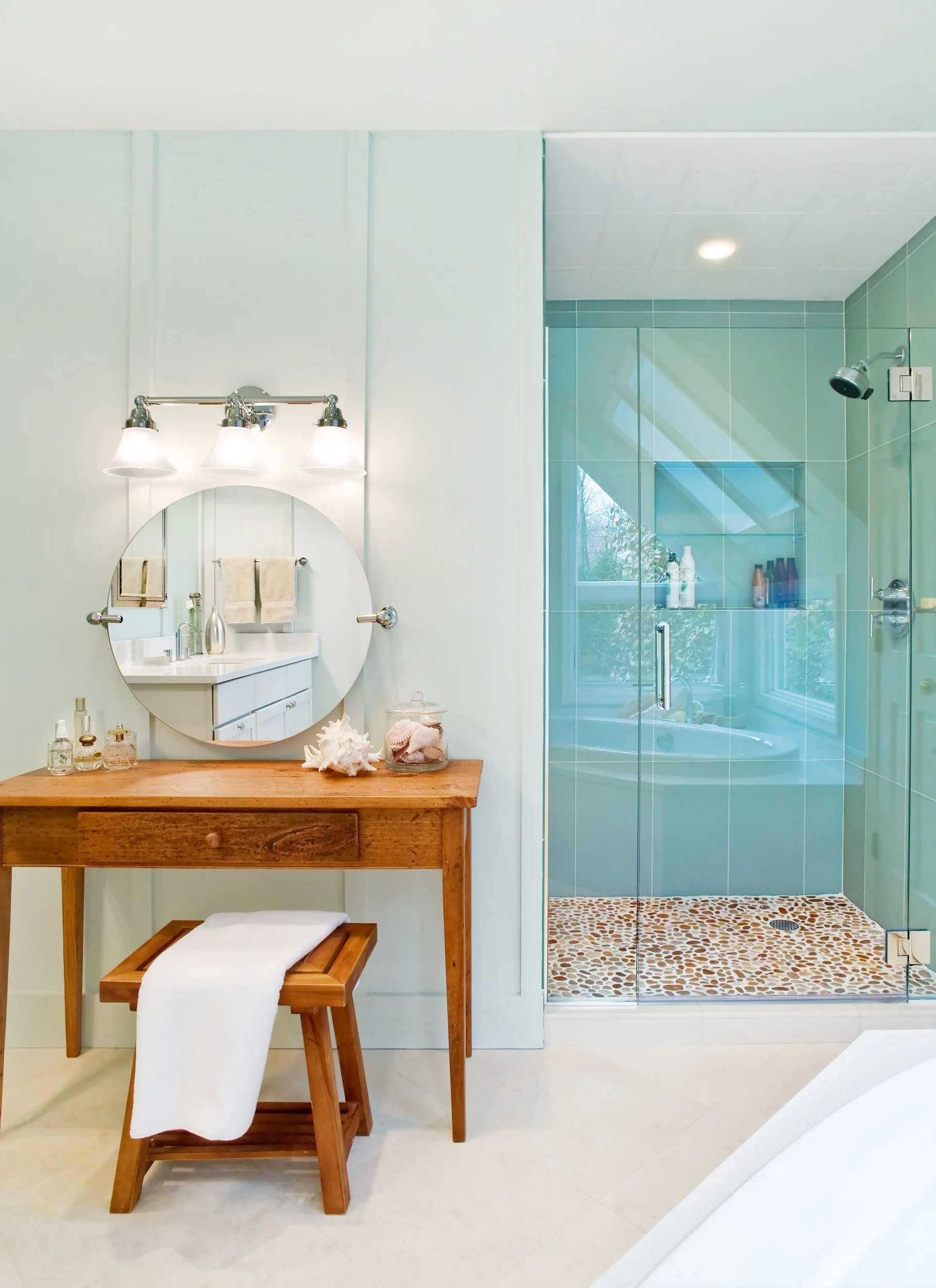
The Deerfield House project was recognized at the Metropolitan Design Competition with three awards: Best of the Best, First Place for Small Bathrooms, and Second Place for Large Bathrooms. The competition, a juried program focused on work in the New York metropolitan region, evaluates projects on planning rigor, spatial intelligence, and execution. In this case, the jury’s response reflects a problem solved across two very different rooms shaped by the same underlying architectural condition.
At the center of the project was a structural complication rather than a decorative one. The primary bathroom sits above a two-story family room with a vaulted ceiling, and the resulting rooflines and framing left both the primary and adjacent family bathroom with awkward geometry, leftover volume, and compromised layouts. Over time, these conditions had produced rooms that were neither efficient nor particularly clear in how they were meant to be used.
Rather than approach the bathrooms as isolated renovations, they were rethought as a coordinated pair. The decision was made early to keep plumbing locations largely in place and concentrate effort where it would have the most impact: planning, storage, and the integration of structure into the architecture of the rooms themselves.
In the primary bathroom, the solution reorganized the space to work with the available volume instead of fighting it. A new soaking tub, a separate shower, and a long vanity establish a clear and legible layout, while one of the most difficult elements—the structural bulkhead created by the room below—is absorbed into a custom cabinet rather than left as an exposed interruption. The room’s palette and detailing are deliberately restrained, allowing the plan to do most of the work.
The family bathroom, by contrast, is compact and more tightly constrained. Here, clarity comes from subtraction. Replacing the old tub-and-curtain enclosure with a frameless glass shower allows the room to read as a single volume, while a built-in bench turns another unavoidable structural condition into a purposeful architectural feature rather than a compromise.
What links the two spaces is not their size or style, but the way each is organized around use and necessity. In both rooms, the solutions are quiet, and the structure is resolved through integration rather than concealment.
It is this consistency of thinking across very different conditions that likely led the jury to award both category honors and Best of the Best. The project does not rely on scale, novelty, or visual excess. Its success lies in how precisely the constraints were read, and how little needed to be added to make the rooms work.
The Metropolitan Design Competition was established to recognize work where clarity of planning is as important as quality of execution. At Deerfield, the achievement is measured less in individual features than in the way the rooms now make sense as architecture. A more detailed account of the project and its specific design solutions can be found in the full Deerfield House case study.